
End of era on Offaly's bogs highlighted at Birr launches


THE POIGNANT END of an era on Offaly's bogs was highlighted during the launch of a book and an art exhibition in Birr Theatre and Arts Centre last week.
The book launch was “Bogmen First and Last” by the acclaimed Birr poet Eileen Casey. The art launch was a series of wonderful works of art by four talented local artists. The art exhibition was called “The Listening Hand” and was curated by the highly regarded local artist Jock Nichol. The book launch and the art exhibition were complementary as they were both focussing on nature, with the artists frequently focussing on our bogs.
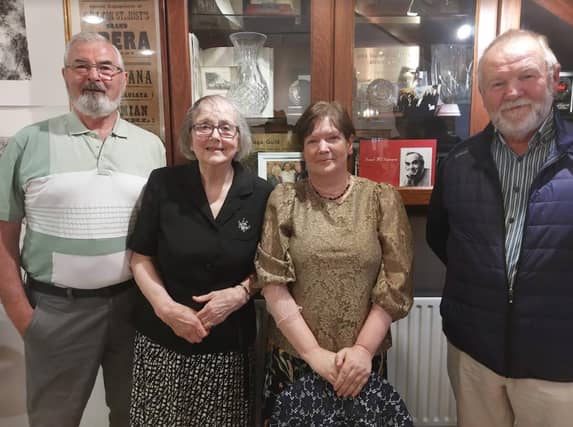
Two former Bord na Móna employees, Seán Craven and Seamus Barron, who contributed to Eileen's book, were present at the launch and talked to the gathering about their many years of working in Bord na Móna, a time which they looked fondly back on and which has come to an end because of the decarbonisation programme.
Introducing The Listening Hand Jock Nichol spoke about the process of engaging with nature as part of a self-healing process. “A friend of mine said to me many of us in society need to start listening to nature more. By that, he didn't just mean the physical act of listening but our emotional engagement with nature. He meant that it's important we should engage with it and respond to it in a meaningful way.” Jock said the bogs of the midlands are going through a very fast and dramatic change at the moment, something which is bringing about a mixture of negative and positive things. Negatively, it means many jobs have been lost. Positively, it means the regeneration of great swathes of the landscape. He quoted a medieval saint, Saint Bernard of Clairvaux who pointed out that “Hearing is a doorway to vision.”
He talked about the other three artists in The Listening Hand. “Pat Fitzpatrick works in the medium of print and he focusses on memory, landscape and beauty...Bridget Flannery is interested in the changing landscape of shoreline, riverbank and bog...Rosemarie Langtry's work is inspired by her love of textures, layers, digging, burying and the process of using her hands.”
The work of Jock himself is the depiction of the changing nature of the bog landscape throughout the various seasons.
Margaret Hogan said she was delighted to launch Eileen's book of poetry. She said she taught Eileen in secondary school many years ago.
Margaret pointed out that the bogs of Offaly are a fantastic subject for poetry because they are beautiful and there is also the strong link between the bogs and people.
She added that Eileen lives in Tallaght but is a native of Birr, where she grew up as Eileen Cordial.
“Eileen is an accomplished, much published, award-winning poet and she has joined the company of those who have celebrated, illustrated and explained Offaly's bogs.
“They have included, amongst others, Tina Claffey, also from Birr, who has achieved international success with photographs recording colourful, often minute wildlife. Tina's recent publication Portal is a treasure.
“John Feehan’s contributions are based on detailed research and analysis.
“Tom Egan, Project Manager of Lough Boora Discovery Park, led the development of several cut-away bogs where people can now explore nature, enjoy outdoor activities and visit acclaimed Lough Boora Sculpture Park where abandoned mechanical material is transformed into fascinating sculptures.
“Eileen's poetry collection “Bogmen First and Last” has supplemented these other contributions.”
Margaret said the book is poignant because it focusses on a once great industry which has now been phased out because of Climate Change and the need for a decarbonisation programme. “For decades Bord na Móna provided great employment to the people of Offaly. It provided vital livelihoods for many. When the company was thriving in the '50s, '60s, '70s it was envisaged that the turf would eventually run out, perhaps in 50 or a 100 years but no one thought Global Warming would be the cause for the end.” She said that she knew many people who worked on the bog, including a couple of her relatives. For decades working on the bog was a major part of many people's lives living in Offaly.
Margaret added that Eileen's book celebrates, records, the many men who worked so hard for so many years on the county's bogs.
Margaret also pointed out that Eileen's work sounds great when you read it aloud. Like all great poetry it revels in the sound of words, words such as “sphagnum” and “whooper”.
In a long poem “Once upon a Kilcormac Time”, Eileen depicts the experience of the workforce since the 1950s, the early rising, the winter mornings, birdsong, pop songs of the time: “acres of brown gold/Tea room in a galvanised hut, camaraderie, slagging, acres of brown, barrow-loads of dust”...
Eileen has had years of experience weaving her words and she expertly condenses generations of work in the Offaly bogs into pages of vivid writing.
Seamus (Digger) Barron had his memories organized into verse by Eileen: “I came to work in Boora in 1969/I got a job as a craftsman/ … A house came with the job/We moved into the house straight after/our honeymoon.”
And Seán Craven's recollections were compiled into a number of lines, including these: “memory fragments: Marino Waltz/ Rationing/ Pallets/ Lorries and Dust/ Timesheets/ Clock Cards/ Stores and spare parts/ so the Plant keeps producing bales,/ Onto Derrinlough Engineering Works.”
There is also a review of the past of the bogs in the book. This past includes a colourful character called David Sherlock (1850-1935) who had dreamt of air dried briquettes and “even had a suit made from bog fibres”; and “wore his peat coat to the amazement of all/But it never took hold.”
Another person from the past was Kevin Farrelly who gave employment selling curative sphagnum moss to troops back from the other Crimean war, that is the one in the 1850s.
Joe Craven “discovered a Mesolithic habitation site … dated 7030 to 6400 BC and now a pathway leads to the site.”
“I know people will like the variety in the collection,” continued Margaret, “how Eileen moves easily from workaday industrial details to landscape and wildlife.
“She celebrates the great machinery, ‘Milling, Ridging, Harvesting’ as well as the Caddis fly, frogspawn, bog rosemary, bog cotton together with the people who worked in the industrialization of the bog.
“It is a book to read and reread, especially, but not only, for Offaly and Midland people, and a book that future generations will treasure as they look around at a different bog landscape, mostly back to nature once more.
“The bogs will never be the same again as they were for those who worked on them from the 1950s to now.
“For present and future generations, Eileen Casey has recorded with keen insight the Midland bog experience pre- and post-millennium in the pages of Bogmen First And Last.
“In another slim volume, Bog Treasure published last year, Eileen shared her creative vision with anthropologist Jeanne Cannizzo, who now lives in Canada, and both women share a talent for reflecting on places and people past and present from Lough Boora, Leamonaghan to Orpheus, Anne Boleyn, Bavaria or North Yorkshire. Their poems are mainly local, skilful, and are not difficult. Their poems are real treasures to keep and share in memory of a workforce who contributed for a whole generation to provide energy for our Celtic Tiger prosperity.”
Eileen thanked Margaret for her very kind words, her former teacher, who had been “a big influence on me.” She said she was very glad to see Seán Craven and Seamus Barron at the book launch. “They are the human face of Bord na Móna, reminding us of the thousands of employees who once worked on the bog. The great industry is now all but gone and I thought it was very important to record the human face of that industry in my book.” Eileen read a couple of poems from the book.
Seán Craven said both he and Seamus worked for forty years in Bord na Móna. “A couple of years ago Eileen sent an email to Kilcormac Development Association looking for help with her book. She wanted to speak to former Bord na Móna employees. Seamus and I contacted her and we wrote down our memories for her. Eileen has created a magical book, a very special book; it means an awful lot to us.” Seán said there was great camaraderie working in the company. Many had nicknames. “There were two guys, both called Bell. Therefore one of them was known as Ding, the other Dong.”
Emma Nee Haslam told the gathering that the art exhibition will be open daily to the public until the end of September. She said Eileen's book is available for sale in the Theatre and in Super Valu.