
Government borrowing drops but debt remains at levels not seen since 1960s

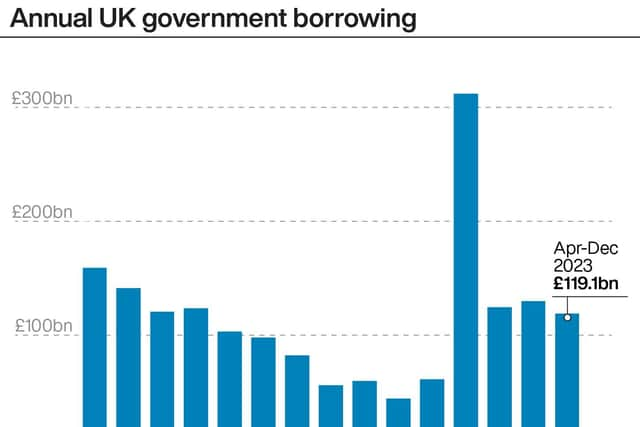
The Government borrowed less money last month than in any December in four years but debt remains at historical highs, new data suggested.
The Office for National Statistics (ONS) said that public sector net borrowing hit £7.8 billion during the month.
“This was mainly due to a large drop in debt interest payments which reflected a fall in monthly RPI (retail price index) inflation in October, while the energy price schemes, which contributed to spending last winter, are no longer in place,” said Michal Stelmach, senior economist at KPMG UK.
“Indeed, government spending on subsidies and other current grants, which included the cost of the Energy Price Guarantee and other support schemes, was down by £5.9 billion on a year ago.”
The ONS said that a year ago changes to student loan repayments came into force and meant that the Government thought it would get about £10 billion more from people repaying their loans.
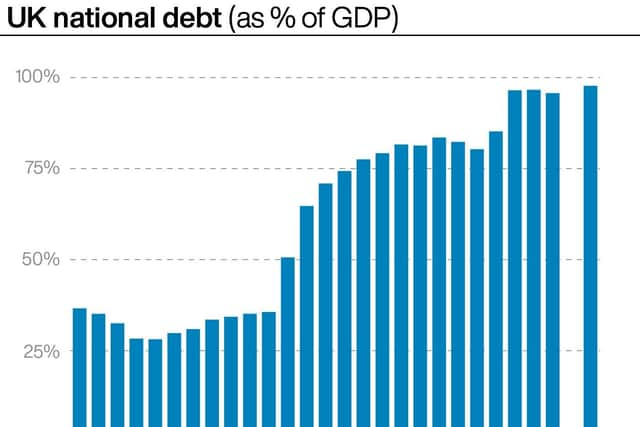
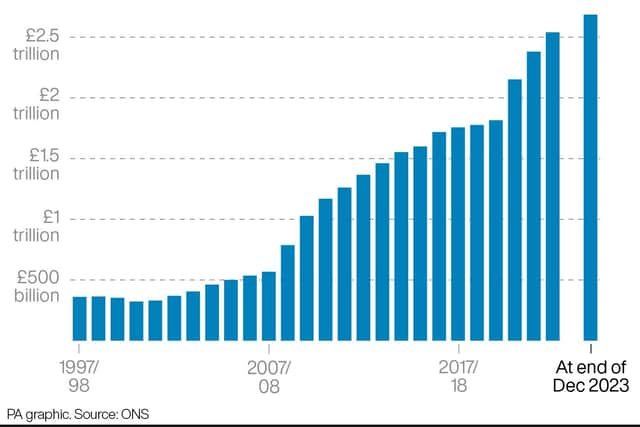
Total net debt was £2.69 trillion at the end of the year, which is around 97.7% of the size of the economy, or gross domestic product (GDP).
Despite the fall in net borrowing last month, the debt to GDP ratio is 1.9 percentage points above last December and still at levels not seen since the early 1960s.
“Protecting millions of lives and livelihoods during Putin’s energy shock and a once-in-a-century pandemic has created economic challenges,” said Chief Secretary to the Treasury Laura Trott.
“Because of this Government’s decisive action, the economy is now beginning to turn a corner. Inflation has more than halved.
“Debt is on track to fall as a share of the economy. And we have been able to afford tax cuts for 27 million working people, and an £11 billion tax cut to drive business investment.”
Samuel Tombs, chief UK economist at Pantheon Macroeconomics, said that falls in gilt yields, that is the interest the Government pays on some of its loans, and the expectation that interest rates will fall will open up more room for the Treasury.
“In the budget on March 6, (Chancellor Jeremy) Hunt almost certainly will cut personal taxes in a bid to improve his party’s chances in the general election,” he said.