
Teachers in England vote for industrial action in autumn term in pay dispute
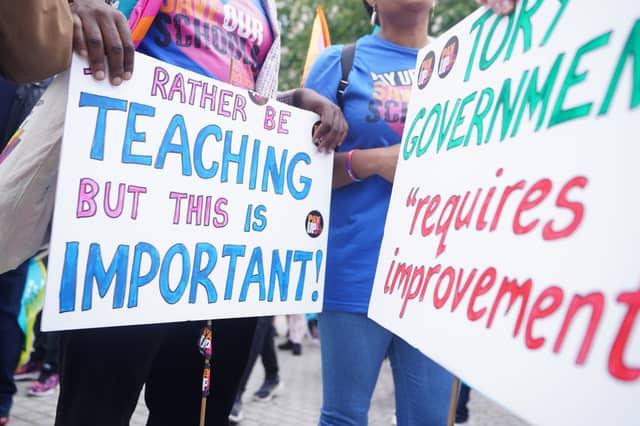

Teachers in England represented by the NASUWT union have voted in favour of industrial action in a dispute over pay.
Nearly nine out of 10 teacher members of the NASUWT union who voted in the ballot backed strike action.
The union – which passed the 50% ballot turnout required by law – plans to stage continuous action short of strike action starting in September in a dispute over pay, workload and working time.
Dates for strike action in the autumn term will also be considered and it will be co-ordinated with other education unions where possible, the union said.
Overall, 88.5% of NASUWT teacher members in England who voted in the ballot backed strikes and 94.3% backed action short of strikes, with a turnout of 51.9%.
Patrick Roach, NASUWT general secretary, said: “Today our members have sent a strong message to the government and to employers that teachers demand a better deal on pay and to address excessive workload and working hours.
“Our members have secured the largest mandate for industrial action by the NASUWT in over a decade, exceeding the government’s anti-trade union ballot thresholds.
“We have today written to the government and to employers confirming the prospect for industrial action in schools the length and breadth of the country from this autumn.”
All state schools in England could be affected by walkouts in the autumn if unions representing teachers and school leaders take co-ordinated action.
Already schools in England have faced eight days of walkouts by members of the National Education Union (NEU) since February.
During the teacher strikes on Wednesday and Friday last week, the majority of state schools in England restricted access to pupils or were fully closed.
The NEU, the NAHT school leaders’ union and the Association of School and College Leaders (ASCL) are balloting their members in England to take action, and their ballots close at the end of this month.
The Government offered teachers a £1,000 one-off payment for the current school year (2022/23) and an average 4.5% rise for staff next year after intensive talks with the education unions in March.
But all four education unions involved in the dispute rejected the offer, and the decision on teachers’ pay has been passed to the independent School Teachers’ Review Body (STRB).
In May, the Sunday Times reported the STRB has recommended a 6.5% pay rise for teachers, but the Government is yet to formally publish the review body’s recommendation.
Dr Roach added: “The Government must stop playing politics, publish the report of the School Teachers’ Review Body and put an end to the damaging speculation they have allowed to develop over recent weeks.
“The STRB’s recommendation of a 6.5% pay award for teachers and headteachers, which has been widely reported, is the minimum to which our members are entitled. However, NASUWT members are clear that teachers deserve better than just another real-terms pay cut.
“The Government is ultimately responsible for teachers’ pay and working conditions and ministers must now get back to the negotiating table to agree a deal that will command the support of our members.”
Last week – when two strike days were staged by teacher members of the NEU – Education Secretary Gillian Keegan warned that teacher walkouts were “undermining” recovery efforts following the pandemic.
Ms Keegan added that she thought she did “pretty well” at securing money from the Treasury for a pay offer made to teachers in March.
Department for Education (DfE) figures suggest that 48% of the 17,450 state schools in England known about were open but restricting attendance and 6% were fully closed on Wednesday last week, when teachers were on strike.
On Friday last week, 46% of the 17,147 state schools in England known about were open but restricting attendance and 8% were closed.
Nearly 122,000 teachers in England were asked to vote in the NASUWT’s recent ballot and more than 63,000 took part.
In January, the NASUWT failed to reach the mandatory 50% turnout threshold required for strike action in England in their original ballot of members.
A DfE spokeswoman said: “Further strike action will cause real damage to pupil learning and even more disruption for parents right across the country.
“Thousands of schools have received significant additional funding as part of the extra £2 billion of investment we are providing both this year and next, which will take school funding to its highest level in history next year.
“We recognise and value the hard work of teachers, but we must balance pay offers with the need to make responsible decisions that are affordable so we can continue to tackle inflation.
“As part of the normal process, the independent School Teachers’ Review Body has submitted its recommendations to Government on teacher pay for 2023/24. We will be considering the recommendations and will publish our response in the usual way.”