
The history of St Giles’ Cathedral, where the Queen lies at rest
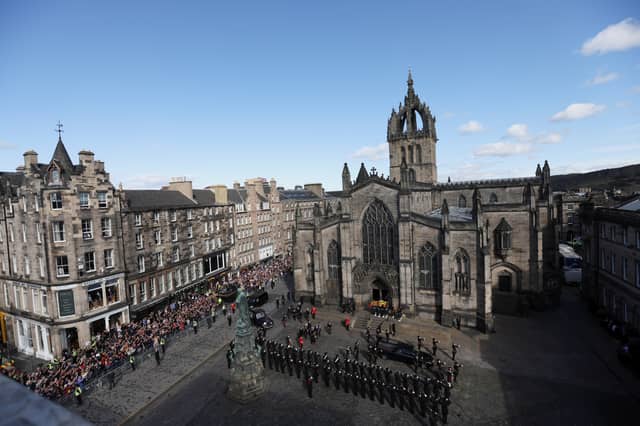

St Giles’ Cathedral has been a focal point for events commemorating the Queen in Edinburgh.
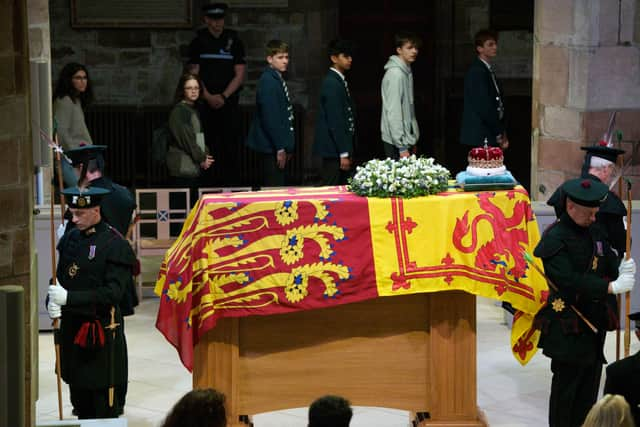
Following a service of thanksgiving on Monday afternoon, mourners have been showing up in their tens of thousands to pay their respects as the Queen lies in state in the historic church.
Founded in 1124 by King David I, the church pre-dates much of the Scottish capital’s Old Town.
Upon founding Holyrood Abbey, the king gave permission for houses to be built towards St Giles’, forming what would become the Royal Mile.
The church came under attack twice in the 14th century, both times by English armies. The first, led by King Edward II in 1322, caused heavy fire damage.
St Giles’ was elevated to prestigious collegiate status by Pope Paul II in 1466 after decades of efforts by the town authorities.
This was followed by the appointment of Scots makar and translator Gavin Douglas – a key figure in the development of early Scottish literature – as provost of the church in 1508.
Change began to develop around the church as the Scottish Reformation emerged. The statue of its patron Saint Giles was stolen from the church one night in 1558, before being thrown into the Nor Loch, and the St Giles’ Day parade was interrupted by protestants who attempted to break images of saints.
In 1559, Scottish reformer John Knox marched an army of followers into St Giles’ and preached there for the first time. The following week, he was elected as its minister and the building began to be stripped of its Roman Catholic decoration.

Following the Union of the Crowns, through which Scotland and England began to share the same monarch despite having separate legislatures, King Charles I in 1637 attempted to bring the Presbyterian Scottish church in line with the Anglican English church.
The controversial efforts prompted a riot after Charles I attempted to introduce a new prayer book in St Giles’ and then made it a cathedral. Church services were suspended for a week in fear of an uprising from the public.
The church was where the arrival of Bonnie Prince Charlie into Edinburgh was announced during the Jacobite rising of 1745. The magistrates of Edinburgh were assembled at St Giles’ to receive the message commanding they surrender the city.
The 19th century brought long-needed restorations to the church, which by 1872 had fallen into a state of disrepair after being split into different churches and rooms since the reformation. The restoration also allowed for centuries-old damage to be attended to.
A donation of £200 was sent to the project’s appeal fund by Queen Victoria.
Elizabeth II’s first visit to Scotland since her coronation was marked with a national service of thanksgiving at St Giles’, where she received the Honours of Scotland.
Her coffin will now remain on public view in the church until later on Tuesday before making a poignant journey to Buckingham Palace in London.