
Dundalk's Peadar O’Dubhda - 'the forgotten man'
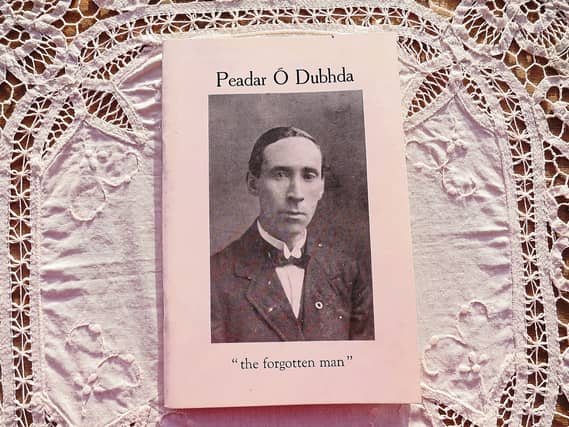

Ian Sherry shares his delight in learning about Peadar O'Dubhda
A little Irish: ‘When one goes abroad perhaps France, Italy or Spain and speaks in English it is taken that you are English or American. Therefore you have to explain that you are from an island called Ireland. Where as if you could speak a little Irish it would tell that you are from an individual country with a culture of its own".
That was Pat Ahern addressing his Irish class in a BBC television programme sometime in the early 1970s. It’s a class remarkable for having in its ranks the local Presbyterian minister Reverent Victor Henderson (a fluent Irish speaker) who tells us that 100 years ago many Presbyterian ministers preached in Irish.
And that a South Armagh minister produced a grammar used for many years. And Mr Chapman in a very cultured English accent tells us that his great great grandfather Pierce Fitzgerald from Ballykinealy in East Cork was a poet and he is learning Irish so he can read his work in its original form.
Pat Ahern was from Dungarvan Co. Waterford; he taught Irish in St Pauls High School Bessbrook and he was our Peadar O’Dubhda. Pat lived in Rostrevor and for 50 years he devoted himself to teaching Irish in the village.
Peadar O’Dubhda was brought to my attention in the library in Dundalk. There before the advent of Covid I spend Wednesday afternoons. For years and years I would pleasantly idle my time.
Shootin’ the breeze with the ‘residents upstairs,’ I was directed to ‘Peadar O Dubhda. the forgotten man’ a book by Padraig O Neill. And a wonderful book it is; a history of Dundalk told around Peadar O Dubhda.
Peadar spent twelve years translating the bible. What discipline! What a fantastic thing to do. To take a book originally written in Hebrew; Aramaic and ancient Greek; a work that has undergone repeated translations and put it into Irish.
To put your ‘own spin’ on the word of God. ‘On 13thJuly, 1955 he presented the Bible to the Nation in the Dail and had lunch with the Taoiseach Mr. Costello’. This is a triumph beyond all.
Many translators of the Bible found their interpretation angered both Church and State and often to an unsavoury degree. I find Padraig O Neills book enlightening. O’Dubhdas sparring with the church and the insight on the cultural and sporting life of Dundalk.
The cycling outings; the music and song in the town hall --- that I heard so much about first hand. We are also told of the hugely successful Irish convention in Dundalk in 1915.
My mothers great friend told me of her childhood in the upper parishes there. When she’d come home from school her granny and a neighbour man sitting each side of the fire and conversing in Irish (their first language) would ask: what Irish did you learn today? And when she’d tell them they’d laugh and say “thats gibberish”.
A reflection on the Omeath dialect and how complex the language is. There's an interesting few lines on O’Dubdah collecting words, customs, prayers and songs for the Folklore Commission ---- from the people of Omeath.
And how (in about 1909) a farmer in Cooley was approached by the police for having his name and address in Irish on his cart. And court proceedings were threatened.
O’Dubdahs friend Father Seamus O’Cuinn the local curate approached all the owners of carts in Cooley who were willing to have the nameplate of their carts in Irish.
The upshot was that O’Connor; a tinsmith in Park Street cut out the plates and Peadar himself painted the names and addresses on each one. With 200 proud owners of carts with a nameplate in Irish the police had no option but to turn a blind eye.
There was another amusing incident that happened in Blackrock in the 40s. Tommy Hollywood filled out the List of the Dead in Irish. It was the custom to read out the names. Fr. O’Hanlon did so but his pronunciation was not of the best.
Tommy complimented him for reading the list in Irish but in an obvious reference to his pronunciation said, “you murdered a few of my dead relatives in the church to-day.”
I have some understanding of Peadar O’Dubhda’s persistence in advocating the Mass be said in Irish. With attendances at the time prayers in Irish would have imprinted in young peoples minds. I was an altar boy when responses and prayers were said in Latin and what Latin I then learned by rote still stays with me today.
Padraig O’Neill’s wonderful book brings vividly to us. ‘Peadar O’Dubhda “the forgotten man.”